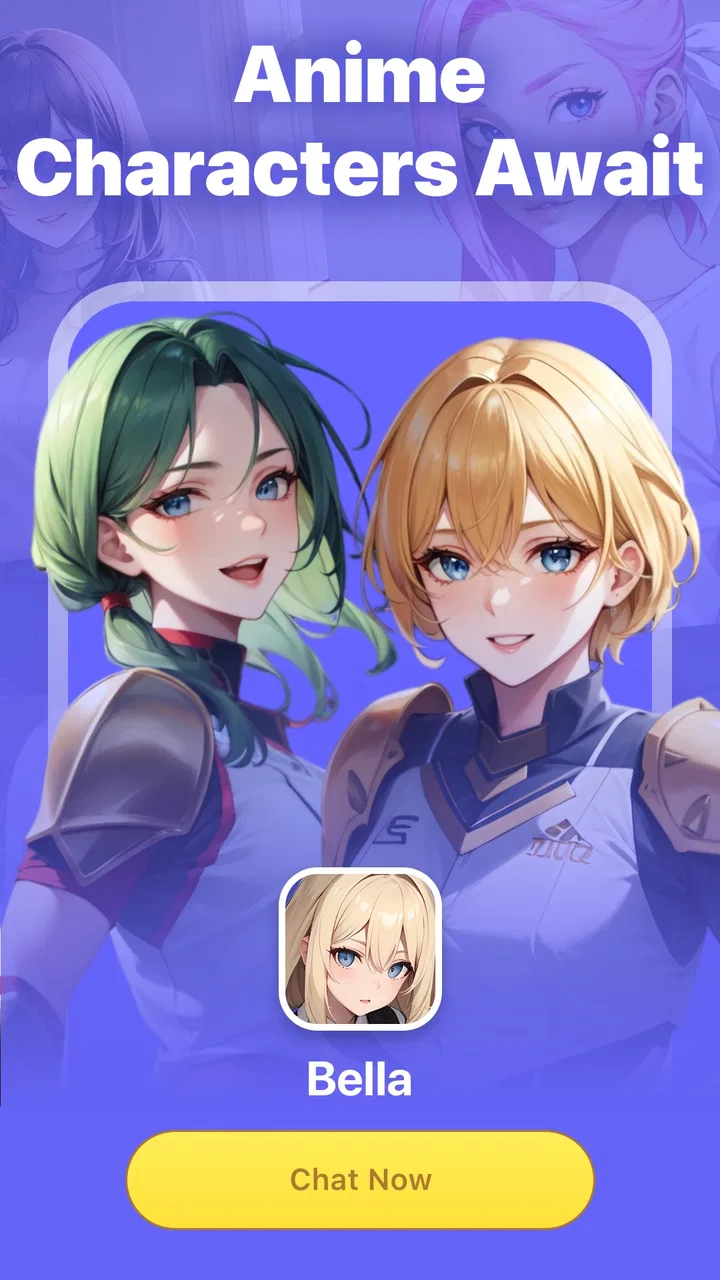
Bella: Anime Characters Chat
- 3.9
- Rating
- 100.00K
- Installs
- Free
- Price

 Analysis by App-foxy
I spent time with Bella: Anime Characters Chat as an entertainment app built around conversations with anime-style companions. Its central idea is easy to understand: you open a chat, choose a character, and use the exchange to build a story in your own direction. That sounds simple, but the quality of the experience depends less on the visual theme than on how much patience you bring to an open-ended conversation.
My first impression was that Bella works best when I treated it as an interactive writing space rather than a conventional game. There is no need to chase a score or complete a traditional level. Instead, the fun comes from setting a scene, giving a character a problem, and seeing how the conversation develops. For readers who enjoy anime-inspired roleplay, improvisation, or casual character chat, that makes it an appealing idea. For anyone expecting a fully structured adventure with carefully authored branches, the experience may feel looser than expected.
What the chat experience feels like in everyday use
The app comes from APPS4FREEZ and sits in the entertainment category. It is free to start, with optional purchases shown between $1.99 and $49.99 per item. That range matters because a free download can still become an ongoing paid experience if you use it frequently or want access to additional options. I would approach it as something to sample first, not as an app to buy into immediately.
You May Also Like

 Blood Strike: 2.5 Anniversary
Blood Strike’s Loadouts Turn Every Drop Into a Tactical Gamble
A close look at Blood Strike’s custom loadouts: how fast access to signature weapons reshapes its battle royale rhythm, rewards preparation, and narrows the gap between fights.

 Pandora - Music & Podcasts
Pandora’s Music Is Easy to Start, but Harder to Recover
Pandora’s strength is its low-effort path from a seed to a station. Its weak spot is how much confidence it asks you to place in connection, setup, and quiet recovery.

 8 Ball Pool
 Is Built on Rivalries, Rematches, and Routine
A close look at the rivalries, rematches, shared routines, and unanswered safety questions that turn a quick pool match into a persistent mobile community.

 Samsung Music
’s Quiet Strength Is Playing What You Already Own
Its reach comes less from spectacle than from dependable access to a personal library. That simplicity is both the app’s strongest retention engine and its ceiling.

 AccuWeather: Weather Radar
AccuWeather Review: A Quick, Clear Forecast for Everyday Decisions
For everyday plans, the best forecast is the one you can understand quickly. AccuWeather makes rain timing, radar, and local conditions easy to act on, with a few trade-offs.

 Hill Climb Racing
Why Hill Climb Racing Still Turns Crashes Into One More Run
A tiny car, a bumpy hill and one more upgrade: Hill Climb Racing keeps resurfacing because its simple chaos makes every near-miss feel personal.
More From Our News Desk



Bella is marked Mature 17+, which is an important part of deciding whether it belongs on a shared family phone. The conversational format can invite personal, romantic, dramatic, or otherwise mature roleplay depending on how it is used. I would not hand it to a younger teenager simply because the interface looks playful or anime-inspired. The age label should be treated as a practical boundary, not as a minor store detail.
The app reached the store on September 24, 2024, and the current release is version 1.0.4. It requires Android 6.0 or later, so compatibility should be comfortable for many older Android phones. That does not automatically mean every device will feel equally smooth, though. Chat apps can be affected by memory pressure, keyboard behavior, background restrictions, and network quality, so a phone that technically runs the app may still offer a less comfortable session than a newer model.
Its average rating is 3.9 from around 2.6 thousand ratings, with 409 written reviews. I read that as a mixed but reasonably encouraging signal: enough people have tried it to form a recognizable impression, yet the score does not suggest that every user finds the conversations consistently satisfying. The install count is over 100 thousand, which gives the app a visible audience without making it feel like an established mainstream platform.
Why the open-ended format can be enjoyable
The strongest part of Bella is the freedom to decide what the conversation is about. I could begin with a normal greeting, but that usually produced a less memorable exchange than starting with a clear situation. A better opening is something like, “We are waiting for the last train after a festival, and you have just found a mysterious key.” A prompt like that gives the companion a setting, a mood, and an immediate reason to respond.
This leads to my first practical insight: specific scene-setting is more valuable than sending longer messages. A short prompt with a location, relationship, and small conflict gives the chat something to work with. A long paragraph full of unrelated instructions can make the exchange harder to guide. I found that one event at a time kept the storyline clearer and made it easier to correct the direction when the character wandered.
The app also suits people who want a low-pressure creative outlet. I can use it to test a dialogue idea, improvise a short anime-style scene, or simply pass a few minutes with a fictional companion. It is less demanding than writing a full story from scratch because the character supplies a response, but it still rewards users who contribute details rather than waiting for the app to do everything.
That distinction is important. Bella is not a replacement for a finished anime series, a visual novel with authored routes, or a multiplayer community. Those alternatives offer stronger continuity, richer presentation, or human unpredictability. Bella’s appeal is the immediate back-and-forth. It gives me a private space to steer a scene, but the trade-off is that the story can feel improvised rather than polished.
How I would use it during a normal day
A realistic use case is a short evening break. After work, I might open a chat and create a scene in which an anxious student has to prepare for a festival performance. I can ask the companion to play a supportive friend, introduce one complication, and continue for ten minutes. That is enough time for a small emotional arc without committing to a long session.
Another useful scenario is brainstorming. If I am stuck on a character’s personality, I can ask the companion questions in character and observe which answers suggest a consistent voice. I would not treat the replies as authoritative writing advice, but they can help me discover possible conflicts, relationships, or dialogue rhythms. The result is closer to improvisational rehearsal than to a dependable writing assistant.
On a commute, the format is convenient because a conversation can be paused and resumed around other tasks. However, I would not rely on it during a moment when I need uninterrupted access. A chat that depends on a live connection can become frustrating on a train, in a crowded venue, or in a building with weak reception. The app is best used when I have a stable connection and enough attention to read and respond.
That is the second non-obvious trade-off: the app’s portability is also its weakness. A phone makes character chat easy to reach, but mobile conditions are unpredictable. Notifications, poor reception, battery-saving settings, and a cramped keyboard can all interrupt the mood. For a quick exchange this is manageable; for a carefully developed storyline it can break the rhythm.
Connectivity changes the mood more than expected
Network-dependent moments are especially noticeable in a conversational app because each response is part of the performance. In a regular offline puzzle, a brief connection problem may not matter. Here, waiting for the next reply creates a visible gap in the dialogue. If I am in the middle of a dramatic reveal, that pause feels like a scene stopping between lines.
I therefore recommend starting important story sessions only when the connection is dependable. If I know I will soon enter an underground station or move between networks, I keep the scene casual rather than beginning a complicated storyline. This is not about avoiding the app; it is about matching the type of use to the conditions around me.
When a response fails or a session becomes interrupted, my preferred recovery method is simple. I restate the last important event in one compact message instead of trying to recreate every previous line. For example, I might write, “We are still in the station, the key is in my hand, and you just warned me not to open the door.” That gives the conversation a usable anchor and avoids wasting time on a full recap.
This recovery habit is more effective than sending several frustrated corrections. Multiple overlapping messages can make the intended direction less clear, especially when I am already unsure whether the problem came from the connection or from the conversation itself. A short continuity note keeps the scene moving and gives me a practical way to regain control.
I also learned to separate story instructions from spoken dialogue. Writing “You are the detective, but do not reveal the culprit yet” is clearer than burying that request inside a long paragraph of character speech. This creates a cleaner workflow: first define the role or scene rule, then write what my character says. It is a small change, but it reduces accidental shifts in tone.
Using the app without wasting mobile data
Chat messages are generally lighter than video or image-heavy entertainment, but a data-conscious user should still pay attention to how long sessions last and what else the app may load during use. I would begin with short conversations on mobile data and reserve extended roleplay for Wi-Fi, particularly if I planned to keep a storyline going for a long time.
My third practical tip is to prepare a compact story outline before opening a longer session. Three lines are enough: the setting, the relationship, and the next problem. This reduces idle back-and-forth and makes each message more purposeful. It also helps if the connection drops, because I can reconstruct the scene from those anchors rather than trying to remember a sprawling conversation.
I would also avoid repeatedly resending a message when the app appears slow. First I would check whether the message actually went through, then wait before trying again. Duplicate prompts can produce confusing replies and may use more data without improving the result. In a mobile setting, patience is not just convenient; it helps keep the conversation organized.
People who are careful about spending should pay attention to the purchase flow as well as their data use. Bella is free to download, but optional items range from $1.99 to $49.99. I would decide in advance whether I am only testing the basic experience or whether I am comfortable paying for extras. The upper end of that range is significant enough that casual curiosity should not turn into an accidental purchase.
Where Bella is a good fit—and where it is not
I think the app is a good fit for anime fans who enjoy making up scenes, users who like conversational roleplay, and writers looking for a playful way to challenge a character idea. It can also work for someone who wants a private entertainment activity that does not require coordinating with other people. The user controls the premise, which makes it easy to experiment without worrying about an audience.
I would skip it if I wanted a complete story with a guaranteed ending. A traditional visual novel is better for authored pacing, established character development, and meaningful choices that have been tested by a writer. If I wanted spontaneous conversation with real people, a social chat community would offer a different kind of unpredictability. If I wanted a serious productivity tool, Bella would be the wrong choice because its purpose is entertainment and imaginative interaction.
There is also a continuity limitation to keep in mind. Open-ended character chat can drift. A companion may forget a detail, soften a conflict, or respond in a way that does not match the personality I imagined. I found that accepting some improvisation made the app more enjoyable, while demanding perfect consistency made it feel disappointing. Users who care deeply about canon accuracy or long-form narrative control may become frustrated.
The mature rating creates another boundary. I would use the app thoughtfully in public and avoid treating fictional conversation as a substitute for real emotional support. A companion can help me explore a scene or fill a quiet moment, but it cannot provide the accountability, care, or judgment of a trusted person. That distinction is especially important when a conversation becomes personal or emotionally intense.
Small techniques that make conversations better
One technique that worked well for me was giving the character a limited choice. Instead of asking an open question such as “What happens next?”, I might offer two possible actions and ask the companion to choose one. This creates momentum without removing creativity. It is useful when the conversation starts circling or producing vague replies.
Another is to introduce consequences gradually. If I add a new secret, location, character, and crisis in the same message, the scene can lose focus. I prefer to establish one detail, let the companion react, and then add the next complication. This makes the chat feel more like a developing scene and less like a list of instructions.
I also found that ending a session with a brief status note helps when I return later. I can write down who is present, what they want, and what unresolved event is waiting. That note is useful after an interruption and makes the next opening message more precise. It is a simple workaround for the natural fragility of improvised storytelling.
These habits reveal Bella’s real strength: it gives me tools for directing a conversation, but I still have to provide the creative structure. Someone who wants to sit back and be entertained may find the results uneven. Someone who enjoys guiding a fictional scene will have more control and probably get more value from the free experience before considering any optional purchase.
My final view on the connected-chat experience
After using Bella as a mobile entertainment app, I see it as a lightweight playground for anime-inspired conversation rather than a full game or a replacement for social interaction. The concept is approachable, and the ability to create personal storylines gives it more flexibility than a fixed script. I especially liked the way a carefully chosen setting could turn a plain greeting into a small scene.
Still, the experience depends on realistic expectations. Connectivity can affect the timing of replies, mobile interruptions can weaken immersion, and open-ended characters may not maintain perfect continuity. The free entry point is helpful, but the optional purchase range deserves attention before spending. Those are not minor details; they shape whether the app feels relaxing or frustrating in everyday use.
My recommendation is selective. If you enjoy anime character roleplay and are happy to guide the story with clear prompts, Bella is worth trying on a stable connection. Use short scene anchors, keep important sessions on reliable Wi-Fi, and treat purchases as optional rather than necessary. If your priority is a polished, offline-ready narrative or dependable long-term character consistency, I would choose a traditional visual novel or another established alternative instead.
For me, the deciding question is not whether Bella can replace other entertainment apps. It cannot. The better question is whether I want an interactive chat that turns a few minutes of free time into a small fictional scene. When the answer is yes—and the network is cooperating—the app offers a pleasant, flexible way to do exactly that.
FAQs for Bella: Anime Characters Chat
01What is Bella: Anime Characters Chat?
Bella: Anime Characters Chat is an entertainment and role-playing app that lets you interact with anime-inspired virtual characters through text conversations. After opening the app, you can choose a character or conversation style and exchange messages as if you were chatting with a fictional companion. The experience is designed for casual fun, storytelling, and imaginative conversations rather than real human communication or professional advice.
02Is Bella: Anime Characters Chat free to download and use?
The app may be available to download for free, but some characters, conversation features, message limits, or customization options can require in-app purchases or a subscription. Before starting a chat, check the pricing information shown in the app and review the purchase terms carefully. Availability of free credits and premium content can also vary depending on your device, region, and current version.
03Does Bella: Anime Characters Chat use artificial intelligence?
Bella: Anime Characters Chat appears to rely on automated conversational technology to generate replies based on your messages and the selected character. Because these responses are generated rather than written in real time by a person, they may occasionally be repetitive, inaccurate, or inconsistent with the character’s personality. Treat the conversations as fictional entertainment and avoid assuming that every answer is factual or dependable.
04Is Bella: Anime Characters Chat safe for children?
Parents should check the app’s official age rating, privacy policy, and content settings before allowing a child to use Bella: Anime Characters Chat. Virtual character apps may include mature themes, suggestive conversations, advertising, or features that encourage purchases. It is also important to explain that the characters are fictional and to avoid sharing personal information, photographs, passwords, location details, or other sensitive data during chats.
05What personal information should I avoid sharing in the app?
Even when chatting with fictional anime characters feels private, you should avoid entering sensitive information such as your full name, home address, phone number, email password, financial details, school information, or exact location. Do not share private photographs or identifying details about other people either. Review the app’s permissions and privacy policy, and remember that chat data may be processed or stored according to the developer’s practices.
Pros
- Wide range of anime-inspired characters to chat with
- Simple interface that is easy to navigate
- Offers entertaining conversations for casual use
- Character personalities add variety to interactions
- Suitable for fans of anime-style virtual companions
Cons
- Some responses may feel repetitive over time
- Conversation quality can vary between characters
- Advanced features may require in-app purchases
- Requires an internet connection for most interactions
- Privacy details should be reviewed before sharing personal information

Bella: Anime Characters Chat
Gallery